Thursday, October 10, 2013

LAFAYETTE

What ever may or may not have been taking place during the incipient stages of Lafayette, Andrew Carmellini has tied up any of the loose ends and fashioned them into an intricate, beautiful weave like a hand-tatted doily.  Carmellini is one of those smart, super talented chefs that can cross genres, and pulls them off flawlessly.  Locanda Verde (Italian) is going strong coming up on five years, The Dutch (New American) is so busy it's next to impossible to get a table and Lafayette (French) is destined to become another gilded notch on his collar.  And it couldn't happen to a nicer guy.

Lafayette took over the old Chinatown Brasserie: it's a big restaurant, with additional outdoor seating that I was able to take advantage of given this revisit to July-like temperatures (thankfully, with slightly relenting humidity).  Under breezy cobalt blue umbrellas, we pulled up sturdy picnic chairs to a marble table.  Angled away from the busy traffic of Lafayette street, you could almost imagine yourself in a grand cafe in the south of France.  White-washed wood and glossy white subway tiles set off the blue accents, giving it a Provencale air tres authentique.  It would behoove you to begin your meal with a cocktail: their list is provocative- fresh and seasonally balanced.  I tried the Crochet Rouge,  a bourbon-based drink that sipped subtly of malt and brightly of citrus, expertly balanced and supremely drinkable.  Our genial sommelier helped us unearth an unfamiliar wine (from their rather pricey list).  We procured a reasonably priced ($45) bottle of WEinbach Sylvaner, and marveled at its robust perfume, and lusty body.  I dubbed it the Marilyn Monroe of white wines, voluptuous and tantalizing.  It paired well with our entire repast.

As the wine was voluminous in flavor, so are the dishes.  Many salads are big enough to split, and at these prices, that's not a terrible idea.  I think one could probably get away with sharing an appetizer and entree, each with a side and dessert plus wine, and come away feeling regally sated for under a $100.  Going the traditional route, however, will tax you noticeably more.  Extraordinarily crisp local butter lettuce is heaped on the plate, anchored down by crumbles of exceptional, pungent Roquefort and swaths of
 country ham in a light herbal vinaigrette.  Even better is the roasted beet root tumbled with soft,
 earthy tufts of mache, tempered ribbons of pickled red onion, crunchy caramelized cashews on a dense pillow of fragrant bergamot yogurt, gently citrus and unctuously rich.    There are several other appetizers I'd avidly return for, including an octopus with charred eggplant, although I'm sure if I do I'll be too late for the arugula with organic strawberries or the heirloom tomatoes with feta and pancetta.  There are French Market offerings we missed as well, such as sweet peppers and breakfast radishes, and a tempting Maine crab a la nage.  Heartier options like pate or tartare might endure a little longer.


A return visit might also include the highly recommended black fettucine, or cocquilles with beef cheek and brebis- both dishes that remained in the running right up until crunch time.  Lamb chops Marocaine made up for any carnivorous deficit, however, luckily ordered medium (because even then were on the rare-ish side), three chops teepeed over beady Israeli couscous and some confited shoulder, melted leeks and whole Lilliputian carrots.  Plates are fairly well-balanced, including vegetables and starches not necessarily noted on the menu.

 Thus, a side of brussels sprouts may not have been requisite, but they were wildly appreciated- fearlessly roasted with thick chunks of bacon and horseradished smudged with garlic.    Not to be missed, even if you don't think you need them.  East coast halibut was another last hurrah
 of summer, perched atop a sweet slurry of corn with a vermillion sauce poivree.   Wood-grilled trout, however,  trumped of the piscine dishes, its silky flesh permeated with a profound smokiness, reminding why this fish is so commonly used in appetizing.  The lingering char trickled down into a toothsome bean ragout, which mingled a variety of legumes with yellow and green haricots, all brightened with a vibrant  orange-inflected citronette.


For a finale, we went out in grand style: a Belles Poires tart for two, which was easily big enough for four or more.  Gossamer layers of buttery pastry cradled tender, spiced pears in a thick smear of
pistachio custard.  A small scoop of cooling yogurt sorbet kept its distance so as not to sog its ethereal crispness, but ready to anoint individual bites as desired.  Belles, without question.  Perhaps even more remarkable (and I guessed it!) was the sublime coffee (decaf!) served alongside: Stumptown at its absolute finest, thick and chocolately, gulpably smooth but sippably decadent.  This was certainly among the best coffee I've ever had... and how fitting.

Our waiter bid us adieu with a somewhat scripted adage, but his sincerity behind the words was unmistakable.  So it is with anything that chef Carmellini touches.  Perhaps there was a hiccup or two upon opening Lafayette, but he is a chef much too smart, much too talented, capable and respected to have left any of that to persist.  Perhaps our waiter's words were a bit foreign to his tongue, but given a little time, he'll have it rolling out as effortlessly and eloquently as Lafayette has shaped up to be.


380 Lafayette Street
New York, NY 10003
(212) 533 3000


Sunday, October 6, 2013

SALINAS

How do you say "favorite" in Spanish?  Because that's what this relatively new Chelsea tapas-focused Spaniard has become.  A mecca of robust flavors, it balances traditional and creative Basque under the deft hand of San Sebastian native Luis Bollo, an established and award-winning chef who is worth every accolade.  Salinas is on the east coast of Spain, but towards the west edge of Chelsea, and in no way too far or inconvenient to beeline to, regardless of where you're coming from.

The room has a sultry quality to it, not in temperature, but with a swankiness that feels mysterious.    White-washed exposed brick and glossy black limit the color palette, aside from voluptuous bouquets of ruffly, heavy-headed roses, in deep oranges and pinks, bunched in monochromatic masses that break up the darkness.  They are also used, ingeniously, to break up a communal table, thus sequestering each end to be used as a two-top, divided by the massive flowers, without moving any furniture around.  Deep blue velvet booths are tucked neatly along the periphery, and a large, open-air room in back can either hold an overflow of reservations, or be reserved for private affairs.  Given the appropriate circumstances, any romantic sentiments might easily escalate with the inspiration from flickery candles,  glowy lighting and the tumbles of blooms.

The food has a sexy quality to it as well, edging towards decadence without excess.  We began with the traditional  pa amb oli (Catalan for bread with oil),  but this crusty bread grilled smoky was anointed with fresh, garlicky crushed tomatoes as well as its drizzle of fruity
 olive oil.    The juices will run down your chin: care less about
 this than procuring your fair share.   Another classic plate is patatas
 bravas, Salinas' version using cubed morsels of waxy potato fried crisper than crisp, buttery smooth inside and thinly smeared with a zesty coat of spicy mayonnaise.


 But the standout dish of the night was inarguably the Coles e Colifor, featuring florets of cauliflower and halved brussels sprouts, grilled to a rich roastiness and nuzzled into a plush pillow of thick, lemon zest-infused yogurt.  Pimenton de la vera adds a touch of woodsy smoke and a kiss
of heat, and one order to share amongst four people was nothing short of inadequate.  The wonderful thing about tapas-style dining is that one's order can be augmented throughout, so an indispensable 'refill' of these arrived swiftly, despite the increasingly populated dining room and constant circulation of runners ferrying enticingly fragrant platters and emptied trays to and fro.  Alcachofas Fritas are fried to an inimitable crunch, paired with perhaps a few too few small, sweet candy cane beets and a scatter of toasty pignoli.  A smooth emulsion of rulo, only mildly goaty, is brightened with lemon and accompanies the rich artichokes for dipping.


Of course, there are meatier tapas on hand as well,  traditional jamons , sausages and artisanal quesos.     We tried the crispy quail decadently cloaked in applewood smoked bacon, four plump drumsticks lolling over a melange of apples roasted with spring onions and tiny caps of shiitake mushroom.

A handful of seasonal offerings are also listed on the menu, as are a few specials your server will describe.  One of these was an under-seasoned sauté of somewhat bland calamares, who took on a bit too much chew whether under- or


overcooked, paired with enormous creamy white beans and morsels of lobster mushroom.  The dish itself was fairly monochromatic: the flavors didn't stray much from its appearance.  On the opposite end of the flavor spectrum rang in a Fideos Canarios from a section of Spanish pastas, which can be ordered as tapas or main course-sized.  Fideos are cut into manageable, abbreviated strands which avoid the Italian twirling conundrum, and these silky, slippery noodles were richly seasoned, thick with umami, salt and depth: this is what Rice-a-Roni is supposed to taste like, but never could.  Tender bits of smoked rabbit coalesce with nubs of roasted green cauliflower, with a moist, oversize scallop standing guard aside flanked with tiny, briny crispy shrimp, creating a surf 'n turf 'n earth par excellence.


Finishing up, any additional food was purely superfluous.  But I had my dad in tow, and when there is bread pudding anywhere in an accessible vicinity, it is simply mandatory.  Salinas' was of the pumpkin variety, a bit chi-chi for the likes of such a traditionally humble sweet, but nonetheless delicious for it.  The pudding side of it featured soft, toasty cubes that held their shape bound with a creamy pumpkin custard and topped with gently spiced scoop of ice cream.  A crisp, buttery plank studded with pepitas spanned the plate and anchored itself in a smooth puree on the opposing end, but the best bites included tidbits from all the components.  I ordered a decaf to go along: this would have paired well with a bitter espresso, but my coffee order went missing- which I actually appreciated, in the end.  I couldn't much fit another morsel of anything on top of an at-capacity stomach, and it didn't make its way onto the bill, either, so I'm guessing she just didn't hear me.  And that was the only snafu of service at any juncture throughout a spectacular meal in a beautiful space with a deft crew, under the thumb of a chef who has garnered my irrevocable admiration.


136 9th Avenue •  Between 18th & 19th Streets 
• 212-776-1990


Thursday, October 3, 2013

BXL Zoute

Why I thought this place was Middle Eastern is a bit of a mystery even to me, except that its name is an unfamiliar hodgepodge of random letters that meant nothing to me, and the signage presents bold, oversize, rusty-looking letters that for whatever reason appeared earthy and exotic, reminiscent of a roadside stand peddling couscous on the cusp of the Sahara.  Instead, BXL stands for Brussels (Bruxelles) and Zoute is salt (Dutch), and the menu's main draw is the Belgian staple,  mussels.  That is pretty much the only thing worth coming for, as well.  Despite the fact that I departed with an unreasonable fondness for the place, the food is not particularly good.
I should have known as much, given that the only citations on its website were for the webdeveloper: no mention of any chef or restaurateur.  But they've established themselves enough to support three locations in Manhattan alone, and the restaurant itself by appearances is rustic and charming, although the location near me is situated at a chronically difficult address.  Frondy palms enclose a patio out front, and the interior is casual, warm and sylvan underneath that looming, enigmatic sign.  Those ominous, metals letters give better indication of the menus foundation than do the bright-faced staff.

We were there early, our servers fully attentive as the rest of the dining room was fairly empty.  I can imagine at a busy brunch or as the evening progressed, a full house might overtax the abilities of the somewhat novice servers, but they are affable and eager, and with a light load handled our orders adequately.  The menu is pretty heavy, and even the lighter sounding dishes ended up a little leaden.  Chicons au Gratin was all ham and cheese,  despite it being described as "endive wrapped it ham".  It was quite literally roulades of ham cloaked in a thick crust of melted gruyere, stuffed with a few spare leaves of endive.  Flavor was great: the ham fresh, rich and salty, and the cheese thick and flavorful, but the proportions grossly skewed from my expectations.  A basket of sort of flimsy bread wouldn't quite hold up to scooping it as a dip, but you can cut off pieces to savor like substantial little hors d'oeuvres- prepare for subsequent appetite-killing, however, if you consume the whole plate.  Even its small side of mashed potatoes (an app with a side.  Huh.)  sat as a dense, leaden lump (at $10, this plate certainly merits its price calorically, but it is more than a bit rich for my tastes).  Other appetizers toe this line, bitterballen,
cheese croquettes, blood sausage, bone marrow. Luckily, there are a fair number of salad options, although many of these could make light meals themselves.  Contributing a lighter footprint is the shaved vegetables, gently seasoned and crowned with a fluffy poached egg atop to dress.  This was actually a nice conglomerate of thinly ribboned vegetables, jicama, radishes, cucumber, carrots and red bell pepper, all crunchy and fresh.

We split a generous crock of mussels, from which there are several flavor options.  Our waiter preferred the Thailandese- but the richness of coconut milk seemed excessive after the heavy appetizers, so we opted for a classic Provencale, which was less tomatoey than normal, but the savory broth tasted nourishing and sincere, redolent of white wine and basil, shards of crisp celery scattered throughout.  Belgians like fries with their mussels, and these are fast-food style, but far superior.  Crisp and salty and hot, with just a hint of grease to lubricate their crunch.  I prefer bread to absorb the broth, but this
variety became too sodden too quickly.  Brussels sprouts, despite
 the eponymy with the restaurant, weren't stellar specimens.  Slightly undercooked, they seems to have spent a little too little time in the oven, and then thoughtlessly tossed with a lot of meaty lardons,  which were actually very lean and tasty, but didn't play well with the al dente veg.


There are other main dishes as well, similarly sturdy: a creamy chicken stew with bacon, meaty Carbonnades and Entrecote, all which seem heavy for a warmish early fall, giving few options for more delicate appetites.  But it's not magnificently expensive, and serves very hearty food comfortably and amicably for when the occasion warrants.  You know your tastes better than I.  The menu's bylines boasts Great Belgian Beer:  if that title alone appeals to you, you'll be in capable hands at BXL Zoute.


 50 West 22nd street
tel.  (646)692-9282

Saturday, September 14, 2013

JUNI

As much as I admired SHO Shaun Hergatt in the Setai Hotel, Juni, Hergatt's latest project, is much more up my alley... as well as being a lot closer to my alley. That puts it, however, on an unlikely stretch of south K-town in the east of a no-man's-land restaurant desert, but not far to the west is Michael White's impeccable Ai Fiori, slightly south Bloomfield's the Breslin and the Dory, then Maysville (despite my abysmal review, appears to be attracting quite an audience), and a host of others.  Thus, chef Hergatt's main obstacle may be to bridge that small stop-gap over Fifth Avenue, because already, in just it's first months of existence, the food itself is almost entirely above reproach.

Juni is billed as a seasonal, vegetable-inspired fine dining, but to me it wasn't so gung-ho
in its vegetable focus as I might have liked.  The dishes are inspired by thoughtfully curated seasonal produce, but they aren't proportionally founded by it.  Of course, most people's idea of plate constitution would coincide seamlessly with his, but I suppose I had a imagined a shift towards a more Michael Pollan-esque, veggie-centric plating strictly from my interpretation of the website's mantra.  Execution, however, was quite succinctly faultless, and the flavors coaxed from flora and fauna alike are nothing less than masterful.  Our waitstaff was almost exclusively Southeast Asian, sometimes requiring a bit of struggle to comprehend past some heavy accents.  But they are attentive and willing, if their graciousness does seem a bit forced: just like Pete Wells at Betony, I'm not sure my purse needed a footstool.

We began with two vegetable-based starters, a corn soup and a garden salad. The cool soup glowed creamy-yellow through a glass bowl, misted with a pulverized freeze-dried egg and a delicate popcorn tuile.  I'm not sure how much it mattered, flavor-wise,  that the egg was from Feather Ridge Farm at this point, as it was separated white from yolk, and desiccated into a fine, pearly dust and a rich eggy crumble.  But it does illustrate their commitment to conscientiously souced ingredients. The Chef's Garden salad was a true showcase of exquisite greens: lovely, tender leaves, translucent discs of radish, and ribbon-thin furls of summer squash hardly needed
 a dressing (although the mustardy daubs and nutty stanchions of almond "sand" complimented their freshness deftly), and added a sunny punch of color  upon bright white porcelain.


I'll admit a tinge of regret for not throwing caution to the wind and ordering the main course offering of arugula-pine nuts-steel cut oats-lovage oil.  For unless it was simply a salad bequeathed with some manifestation of oatmeal, I'm deathly curious to see what this dish might be all about.  However, I wasn't in the mood for a bowl of porridge, nor just another salad, so either option paled in comparison to a crispy skinned branzino.  And when I say crispy, I mean Crispy.   Whether you're supposed to or not, I normally remove the skin from any fish, but these filets were so expertly seared that the crispy edges of skin might have been the best part.  Not to disparage at all the flavorful branzino it was attached to, which came divided into two pieces balanced akimbo upon slender, sweetly steamed carrots.  Flounces of delicate herbs and peppery nasturtium blooms and leaves made the dish look as lovely as it tasted,
 atop a delectably buttery pool of lemon essence and more carrots, this time pureed into thick dollops. Rich pork tenderloin paired with earthy quinoa and an exuberant herb emulsion, deeply vegetal aside two medallions of succulent meat and a brick of salty confit belly.  I'm
not one to normally order pork, but this was an exceptional dish, and the tiny, upturned beech mushrooms, mild cippoline onions and sprigs of dandelion greens and micro-lettuces gave it fresh, summery appeal.


An interesting dessert paired an unlikely trio of grapes, walnuts and mustard, although that latter component was only present as tiny micro-mustards greens, as far as my palate could detect.  Less to impart flavor than for the novelty of a crucifer in a dessert, and continuing the prevalence of produce throughout the menu.  It featured a variety of juicy grapes- some tiny and green as spring, others ebony-black like orbs of onyx, and crunchy red globes full of juice.  Luxurious walnut ice cream compounded the crunchy caramelized nuts hidden throughout, freshened by  a clear, fruity verjus  added
 tableside.  A chocolatey concoction surrounded a scoop of malty, milky ice cream with an artful scaffolding  of spun chocolate, which mirrored the golden filigree decorating the plate.  Fanciful striations of tart plum puree led back to a quenelle of lush sorbet balanced with a diaphanous wafer of crisp pistachio.


All this whimsy, flourish and color is demanded to counter the subdued room, especially as it was relatively unpopulated on my visit.  The color palette is beigey and bland, at least from the vantage point of our table, although livelier paintings are mounted on a far wall, but only visible from a tour around the room.    A somewhat melancholy arrangement of dried magnolia branches would be smartly substituted with a more colorful array, at least until the tables begin to fill themselves with happy diners.  A this point the sparse, minimalist decor seems to be anticipating an influx of guests, as I'm sure is Hergatt himself.  And with food this expertly and thoughtfully prepared, I'm sure they will.


12 E 31st St
Tel: (212) 995-8599


Sunday, September 8, 2013

SPASSO

Even dining with a native Italian, I didn't quite come to understand exactly the meaning of "spasso" until I Google translated it.  Perhaps as the restaurant is counting on traffic from passersby, "spasso" means walking.  And although it is easily within walking distance from my house, I still hadn't been in in the two years or so since it opened, despite it receiving accolades from a trusted source (read: chef).   On a balmy summer night, one not too muggy nor too hot, Spasso presented itself as a optimum destination for an al fresco meal.  Hudson isn't such a busily trafficked stretch by automobiles, so even though it is the street-facing patio in front was that which provided the outdoor seating, it was pleasant to watch neighbors bustling by and other hungry diners on their way to the myriad great dining establishments in the area.

We began with a Boticelli, a refreshing watermelon cocktail of white tequila, pummeled watermelon and a bit of bubbles, garnished with an slice of the melon ample enough to justify its nomenclature.  A cocktail to begin is a good idea if you need a little pre-prandial softening up, for at least if our pours of wine were normative, they are less than generous with the vino.  The sauvignon blanc reached maybe an inch and a half up into the goblet: a meager pour of an ultimately pretty decent wine.  We evolved later to a chardonnay, but alas, same dimensions.  Both glasses together probably added up to a single normal glass of wine. At any rate, the sauvignon well complimented our appetizers,
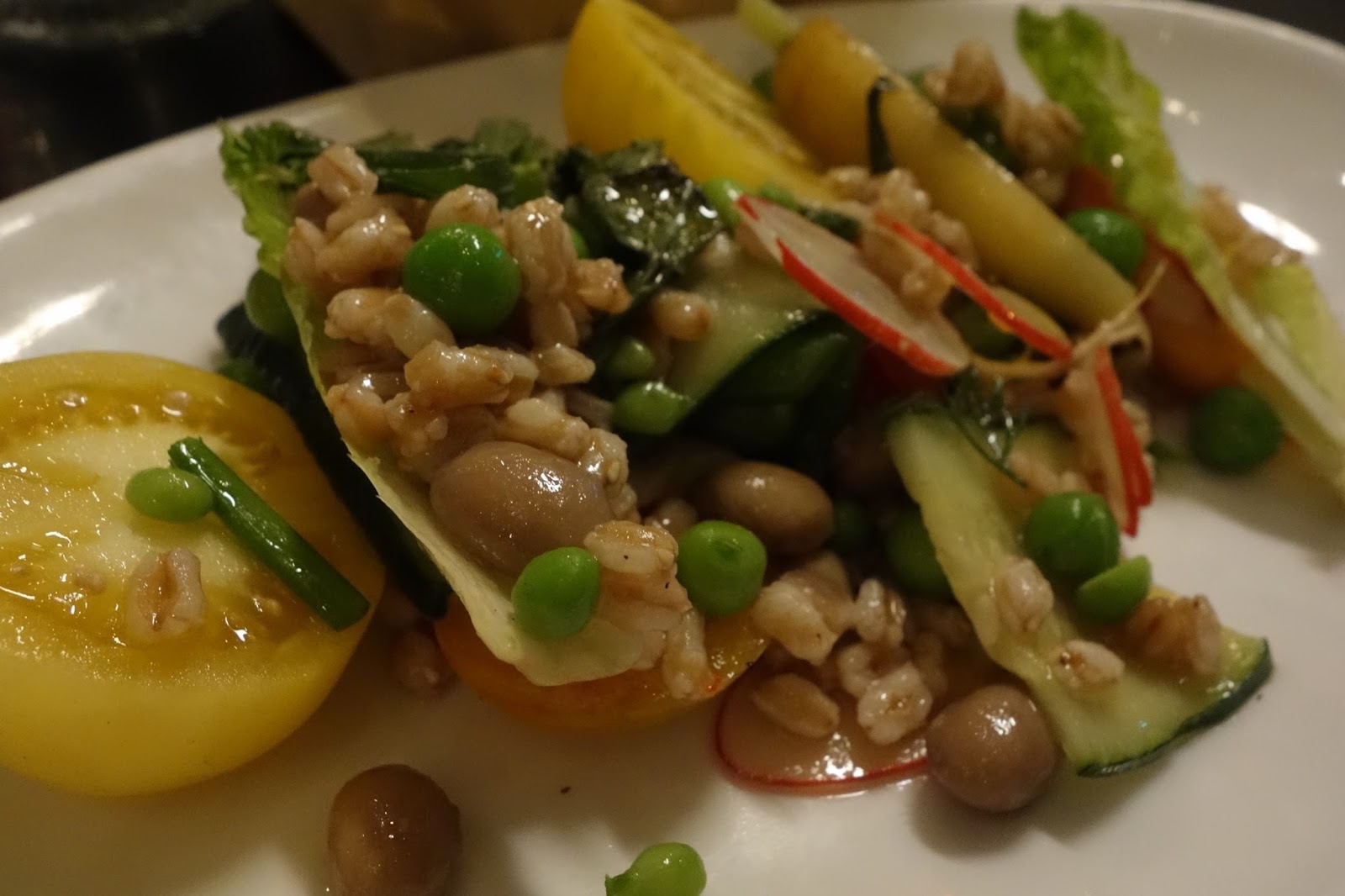
 especially my summer vegetables with farro and herbs.  A summery hodgepodge of peas and beans and beets and carrots tumbled amongst the chewy, nutty grains and legumes in a lightly acidic
 vinaigrette, sprinkled with chervil.  It could have perhaps used a touch more salt (of which there is none a table),but  our second appetizer more then made up for its lack of salinity:  tender tentacles of savory grilled octopus lost some of the flavor of the premium cephalopod to the kitchen's heavy hand with the salt, but swapping bites of the two different dishes actually achieved quite a symbiotic success.    Rustic bread is densely crusted and soft of crumb, provided upon seating and more upon request, if necessary.  A fruity emerald e.v.o.o. is alongside for dipping.


A primi was big enough for a main, although typically in Italiy it would serve as a mid-course.... and this place seems pretty authentic.  We chose a special of the evening, slinky black strascinati smothered in a novel bolognese made with ground squid instead of meat.  Given the Italian aversity to cheese with seafood, it was adorned with a crunchy veil of pangrattato instead of parmesan, which contributed a textural benefit without departing from tradition.  The pasta was cooked perfectly al dente, the sauce was lusty with peak-season tomatoes and fresh garlic, and the bowl consequently swabbed clean with the remainders of our bread.   From secondi  we ordered a trio of seareed scallops, their golden tops so brilliantly bronzed so as to achieve a rich,
 crisp crust, while retaining the ideal tenderness of the remaining scallop below.  Dainty steamed carrots nuzzled into a puree of more of their own, scattered with bright edamame and a flutter of delicate fennel fronds.  Garlicky green beans as a side were a tad undercooked, and suffered a bit from oiliness, but a side dish is a good idea given the sparsity of the plates.  Perhaps opt for the broccoli rabe, or another vegetable side that vary seasonally.


Desserts offer as many choices as the main menu, so it'd be unlikely one couldn't find something to tickle their sweet tooth.  Ours was handsomely sated with a creamy vanilla panna cotta smothered in jammy blueberry compote, bursting with prime, whole berries.  The custard was dense, more like a light cheesecake than a flan, which was riveting under the lively berries.

With the abundance of marvelous Italian restaurants in New York, Spasso presents itself more to me as a superb neighborhood option rather than a destination, although some of its dishes really do shine.  It boasts typical New York prices that are maybe not quite supported by its very relaxed and casual service... illustrated best, I think, by our skimpy pour.  But I can't really find anything specific to fault here either, and there is a lightness and effervescence in the cuisine and the atmophere here, that might leave you in fine form, perhaps, to go a spasso for post-prandial tour of the vibrant West Village.   


551 Hudson Street
tel.  212.858.3838

Friday, September 6, 2013

THE ELM

I never would've thought to put Paul Liebrandt in a hotel kitchen, but this man seems to be able to make anything glamorous.  A striking change from his recently departed Corton, The Elm is comparatively dark and industrial, located in the King & Grove Hotel on the periphery of Williamsburg.  So far, he seems content there, but perhaps this is due to his predicted brevity of stay.  Always forward thinking, he may be contemplating his next project just as The Elm is beginning to take root.  So get here while you can.   The Elm provides a welcome relaxation from the formality of Corton, but the latter is where Liebrandt shines.  That said, most of his glowing talent translates very, very well at this latest venture.


The room is interesting to observe, with long, craning light fixtures arching from the walls, and cleverly constructed tables, made up of wooden slats labeled for the trees from which the wood was derived.  We were welcomed with a tiny, savory olive financier: moist and rich to provoke the appetite, but sized of a button mushroom so as not to kill it.
And then  a small crock of crudites:  shaved, sliced or whole-leafed,  some pickled and some fresh, coiled atop an olive aspic and creamy tuna belly puree that was a little fishy for my tastes, but cool and redolent of deep ocean.  Menus are as simplistic as they could possibly be, divided into sections of provenance:  Raw, Sea,  Land and Share.  I have to say, the share dishes appear to be some of the more interesting looking ones, but they also limit the amount one is able to sample.  And $48 dollars for what we consumed as a two-person appetizer is on the way pricey side- and this one is just vegetables.  Although to say "just vegetables" is erroneously dismissive: these are blatantly not just any vegetables.    I inquired whether they were Farmer Lee's; the quality was at least commensurate.  But no, his are "too expensive"- these are sourced locally and discerningly, and the most rapturous, pristine dirt candy I've
met.  A heavy iron casserole arrives, dwarfing the Lilliputian varietals within.  They say there are roundabout fifty different vegetables in this melange, raw, roasted, steamed, sauteed.  I thought I might try to see how many I could identify, but I lost my count quickly among this delicious cornucopia.  A plate is presented with a funny face made up of condiments: a superb house-made ketchup, a intensely herby puree, a winking eye of crisp Asian pear, and a
pursed mouth made of bitter, candied lemon peel.  It was fun to destroy the face to anoint different bites, although frankly the bites didn't really need improvements.  Furls of stripey chioggia beets, buttery nuggets of marble-sized potatoes, a rainbow of carrots, tender baby lettuces, bubble-sized poppino mushrooms, juicy Ur-tomatoes, lustrous heads of grilled
 baby romaine, tiny immaculate turnips, ruffled matsutake, thick ribbons of zucchini, cross-sections of buttery roasted cauliflorettes, miniature trumpets of golden chanterelles, all scattered with delicate edible flowers.  Savory rice cracker wafers, light as air, floated above, then broken, dissolved to incorporate into the melange below.  It is astounding how delicious such a simple preparation could be, the novelty of each precious, unique bite resulting in a magical sensation of discovery--  child-on-Christmas-morning caliber magic.


A sauce to finish the duck.
Progressing to more substantial fare, we tried the slow roasted duck from Land, with pickled plum and toasted honey... how you toast honey I know not, but it doesn't much matter... because Paul does.   They like the tableside finishings, so it was bequeathed with a fragrant reduction, pooling around the duck.   Its nutty, sweetness tamed the puckery-tart plums, which cut the
 richness of the dense, spiced meat.    From Sea we chose a skate in brown butter with capers, but the classic preparation is here divided and conquered: the tender, ropey flesh of the fish cooked so gently the fibers melt with the pressure of your fork.  A brown butter vinaigrette (also presented a table)  is dispersed in disparate daubs.  It flashed of bright acidity above a bronzed, nutty depth, studded with plump golden raisins and deviantly zesty capers.  A scattering of Marcona almonds lent a textured crunch, and tiny orbs
 of warmed, vibrant yellow miniature lemon cucumbers burst like plump, taut water balloons.  Daubs of mustardy pureed cauliflower and more roasted florets (gleefully, as these were some of my favorite tidbits from the Summer Garden). It was a tough choice between that and  a swiss chard agnolotti with lobster, corn and shishitos, but I've zero regret.  In fact, as is so rare with me, there are many dishes that would lure me back to The Elm:  the Chicken "Kiev style" or the Turbot with summer beans from Share, and scallop gnudi or the "Flavors of Bouillabaisse" from Sea, but I'm sure with the ardent seasonality of The Elm those dishes will have morphed into something more autumnal by the time I might return.
The only dish that I was not flat-out thrilled by was the summer beets with tomato aioli and XO sauce.... unfortunately, the xo didn't translate so much into a kiss as into a wallop of dried fish flavor, trouncing the tomato aioli and the perfectly marvelous baby beets, even when scraped judiciously from their surfaces.  I suppose if you like mackerely-type things, though, you might find this appealing?  But as summer is coming to a close, it may not be even a question worth pondering, seasonally labeled as they are.

Onto sweets, the Eton Mess was anything but messy.  Perhaps less so than at Corton, but the plating at The Elm is still precise and meticulous.  This dainty cupola of brown butter meringue held a delicate violet creme, slathered in syrupy, idyllic tristar strawberries crowned with a diaphanous berry foam.


Peaches & Cream was a stellar combination of voluptuously peachy gelato refreshed by ginger infused basil grantita: this could cool your soul in even the hottest, muggiest New York summer afternoon.  Juicy slices of orchard peaches added structure, with a cinnamony swizzle stick of buttery pastry aside.


  But the show-stealer came again in a shareable portion: an unassumingly named Red Summer Fruit Tart arrived with white-gloved pomp, on its own little cake stand and glass cloche.  It lived up to every morsel of its hype: a buttery layer of shortbread cookie was sprinkled with shards of intense white chocolate underneath a dense layer of custard and ample forest fruits.  Perhaps not all red, but all scrumptious- the Platonic ideals of blueberries and blackberries, strawberries and raspberries.  Lemon confit meringue crowned the masterpiece along with mystifyingly soft cubes of subtly citric lemongrass marshmallow.  The check was accompanied by two housemade chocolate, thinly shelled in profound dark chocolate encompassing a creamy peach center, as well as two fruit gelees.  After the abundant meal, all this may have been gilding the lily a touch, but when a guy's got the Midas touch, he might as well roll with it.


160 N 12TH STREET
BROOKLYN, NY 11249
718.218.1088