Wednesday, June 24, 2015

RED STIXS

Surprisingly, the Phillipe Chow disclosure was not printed on the porcelain.
"*Red Stixs has no affiliation with Philippe Chow or any Philippe Chow Restaurant."  This disclosure
is posted anywhere it can be, apparently at the bequest of the Chow group, with which some of the Red Stixs personnel used to be in cahoots.  The Chows required this stipulation, and Red Stixs's owner conceded saying he would have to keep it visible as such for a couple of years... but if this restaurant lasts that long I will be astounded.  But the one thing that the two restaurants DO share, despite their refusal to play nice with one another in the sandbox, is an overwhelming mediocrity.

To be fair, had I microwaved this food as a a prepackaged frozen entree, I may have been pretty impressed.   Across the board, flavors are monotone, predictable: rarely more than a sum of their parts.  This is the un-Chinese-iest of Chinese foods, mollified for a moneyed, pedestrian palate, who
 don't mind paying too much just to be fed, conveniently and a somewhat chi-chi atmosphere.  There was no punch or vim in anything we tried.  The only advantage this place has is its location:  right in the heart of the Murray Hill food desert, there
really aren't a lot of other options, either.   But for a "Chinese" restaurant to start us off which a tossed salad was just one of the many red flags, all the while accompanied with the signature red stix (sic) with which to eat it.  Not a bad salad, lightly dressed greens fresh as could be, but nothing grander than that, and nothing Asiany at all,
but for a touch of sesame and soy in the vinaigrette.  Fried spring rolls were slightly more successful, but hardly outclassing something you could bake up yourself from Trader Joe's.  They had a bounty of filling, though, tasty mushrooms and cabbage etal., and the wrapper wasn't too greasy, and quite exquisitely crispy.  We selected the vegetarian version of the lettuce wraps, the best part of which was the pale, crisp leaves of iceberg, thick and turgid, and so fun to indulge in after so many servings of mesclun and spring greens.  The filling was wildly less entertaining,

primarily composed of coarsely chopped nuts with cubes of flavorless zucchini and a thick,
 sugary plum sauce to glue things into place.


Chicken satay were strangely tender- soft, even- and even more strangely hued, aside from the fact that satay aren't even Chinese.  Coated in a vivid orange, they imparted a good chicken flavor if you could get past the salt, and were served with a cloying peanut sauce that could be a delicious ice cream topping.  Dumplings arrived in traditional woven baskets, steaming and fragrant.  They were thin-skinned and toothsome, probably one of the safer bets on the menu.


Mixed veg s you've had all of everywhere.
Mixed vegetables... well, you've had them before.  In a cornstarch-thickened white sauce, again too
salty, but the melange of vegs themselves retained a nice al dente freshness- and it's always a joy to eat bamboo shoots.    Chicken and broccoli achieved that same appealing tenderness of chicken, broccoli bright, but again, salt was the prevailing flavor component.    Beijing Chicken's poultry chunks lost the advantage of that tenderness, hardened by overcooking in its dark, bacony gravy, sweet and heady, becoming just about as firm and chewy as the  big toasted walnuts that accompanied it.  Fried rice gained points for presentation, served
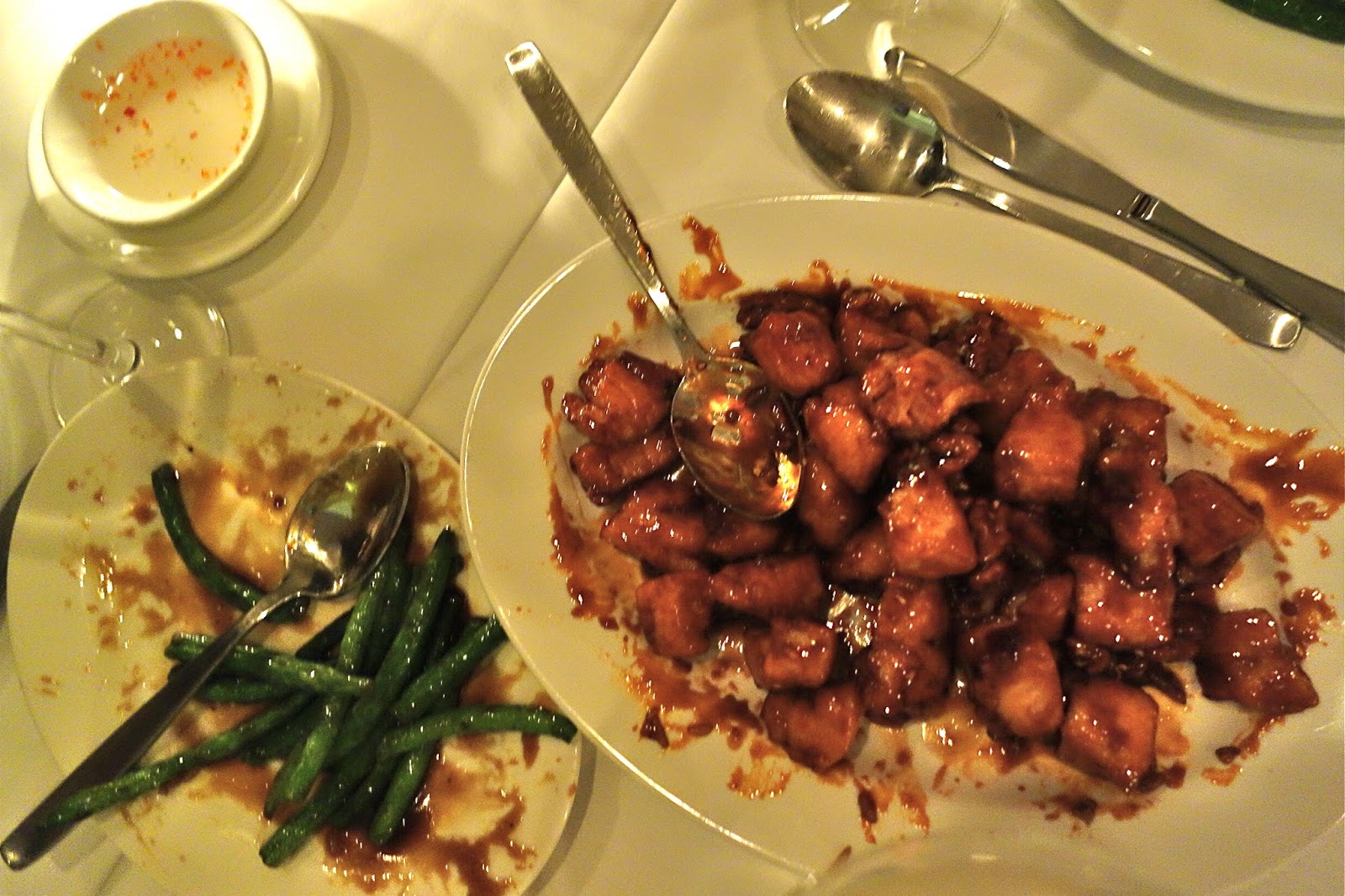
 from attractive tall metal vessels, but was more appealing in situ than on the plate.  The weird squiggles of (alas, more) chicken added an almost comical component, and the taste didn't go leaps and bounds to override the cloche of mediocrity prevailing over the restaurant as a whole.

Actually, in addition to the iceberg lettuce, the only really noteworthy thing I ate that night was a scoop of vanilla bean ice cream from an assortment of gelatos and sorbets (mango, coconut, raspberry, etc.)  that came out to finish things off.  Red Stixs pretty much fails on all counts, but that one white orb, one that has no exclusivity to the restaurant, and nothing at all to do with Chinese food, ended the meal quite pleasantly.


216 E. 49th St. between 2nd & 3rd Avenues 
tel 1-646-964-5878

Thursday, June 4, 2015

COSME

Cosme would be one of those see-and-be-seen kind of joints, were it not so dark and cavernous that it's hard to see where you're going, let alone who else might be there when you are.  And being there isn't the easiest feat to accomplish in the first place; reasonable dining times are next to impossible to come by, even now that it's been open over eight months.  Enrique Olvera caused quite a stir opening up his first New York venture, and the buzz is still fairly audible, if not as deafening as it was in October.  Thankfully, though, some of the best dishes that I had heard about then were still on the menu for my visit, elevating the experience past some of its more obvious missteps.

The darkness of the room was exacerbated by a rather lackluster greeting by two bored  hostesses- young girls casually clad that contradicted the pedigree of the restaurant.   Our server was more adept, describing the layout of the menu and making some recommendations upon our request, although somehow he managed to dribble red wine all over the tabletop each time he poured from the bottle.  And made no attempt to swab it up, nor apologize for the drips, although it's possible he may not have even noticed what was happening in the dimness of the light.  The walls and floors are
 cement grey, concentrated spotlights cast circumspect orbs of light on the walls and tables creating a moody, mysterious ambiance that I wish had conveyed more strongly onto the menu.  Freshness and lightness prevails, which is novel to typical American renditions of Mexican food. too often glopped with cheese or sauce over greasy starches.  Not at all here at Cosme, where in fact, if anything, it could use a little more depth and substance.  The menu is divided into three sections, although they don't vary greatly in price, but apparently separate the heartier flavored dishes from the lighter ones.  It would seem more that the it goes from seafood to vegetables to what might feasibly constitute entrees.  True to that description, however, our initial dishes selected from the first section, were all freshness and light, razor clams which slipped neatly off their elongated shells, brightened with citrus and a zip of crystal hot sauce.  I wasn't expecting a raw clam on this one, but most of the dishes from this first menu section qualify under the guise of crudo.  
Scallop aguachile touted poached jicama, which I was excited try having only ever eaten jicama in its crudite state, but instead, both the scallops and the jicama seemed untouched by heat, only gently cured by the zesty wasabi-cucumber-lime brine in which they floated.  The crisp jicama discs contrasted playfully with such delicate tender scallops, so deceptively similar to the eye but starkly contrary in texture.  My favorite dish arrived next, however: big hunks of king crab leg nestled into a zesty Mexican gribiche studded with salty capers and a flourish of chervil.  The flavors were bright and sharp while rich and luxurious as the same time, served with a crunchy , meta-tortilla chip to render it scoopable.  So far, this would be the only dish I would've returned for, and return for it I happily would.


From the second section (all varying degrees of vegetarian) we chose a purple asparagus, mysteriously bereft of any white eggplant, but lavishly doused in a picante green salsa, which may have been a little overpowering for the vegetal stalks.  They did, however, retain their signature purple tips, ingeniously steamed just long enough to tenderize the sturdy stalks but without sacrificing their regally-hued crowns.
Surprisingly, this dish was better than a much-anticipated mushroom and squash barbacoa, astronomically priced at $26 for an embarrassingly measly portion of steamed mushrooms and a few chunks of grilled zucchini piled over a ruddy pool of romesco-tasting sauce.  There were some dense little blue cornmeal orbs that had potential, but didn't pan out to be much more than gritty balls of compacted polenta... albeit in a fetching shade of greyish-blue.  It would've gotten a little more had it clocked in around $10, but for the price of an entree, neither the size nor the flavor presented any justification whatsoever.  Here, I might've solicited a little cheese, just for the heartiness I inferred from barbeque.  Instead, it was all pleasant and light, but begged for depth and complexity... and an approximate 50% price decrease.  

All the dishes we tried were plated meticulously, in precise compositions that achieved beautiful visual balance.  But the ingredients were so disparate and segregated that it was hard to make the flavors meld in some of them.  The fluke with pork belly was a perfect example of this, whereas combining a morsel of pork with a pickly bit of charred onion,
 a sprig of purslane and a daub of creamy black bean puree created a delicious bite, but that balance so exquisitely achieved in the plating was less easily achieved on a d.i.y. basis.  Too, there could have been quite a bit more of the black bean in order to make the components coalesce.    At $29, it was a medium-size entree- certainly not generous, but adequate.  The duck carnitas, on the other hand, was ample.  Priced at $59, it easily serves two (the table next to us didn't order much else and even took leftovers).  It arrives in a steaming iron skillet, flaunting its crispy-charred skin over a hefty leg and breast- a full half-duck per diner.   Mild shredded fennel and radishes surround the bird, and a stack of earthy, pliant house-made corn tortillas accompany to wrap
up the juicy meat, which apparently takes four days to prepare from a custom blend of blue, purple, yellow and white Mexican corn .  If the quantity of this dish wasn't enough to warrant the price in your mind alone, the effort invested in its creation might tip the scales as further justification.

And then the much-anticipated climax- that dessert I had been reading so very much about (drum roll, please).  And yes, it was that good, really.  A study in white upon arrival, the feathery-light, melt-in-your-mouth meringue broke into a creamy, corny whipped cream mousse to reveal the earthy humility of charred, pulverized husk it was made from.  The unique grey-blue color contrasted gently with the pale yellow mousse, and the subtle perfume of summer corn whispered of a summer which still hasn't quite arrived.  But this dessert transcends the season: my only wish (and I'm not much on dots and squiggles) was that it might have included a tart component to offset the creamy sweetness.  We attempted to outsource this with a scoop of dragon fruit-mezcal sorbet, forgetting that the fruity, supermarket renditions of this flavor are even remotely indicative of the true essence of dragon fruit.  Instead, its muted, almost creamy flavor offered more of the same, with a slight boozy touch (which was not unappreciated).  I suppose I was envisioning the kick of raspberry... a simple raspberry sorbet would've added a nice tangy kick.  Cosme isn't a flawless as I might have hoped, and at these price points I feel like it might have a couple of points to rethink.  But it seems the Chef is probably back at Pujol, having garnered a solid three stars from the Times, and a following frantic enough to require ample forethought to procure a reservation.  But if you have the wherewithal, Cosme is most definitely a memorable experience, although I'm not sure whether it more for the bragging rights than of the dinner itself.


        35 E 21st Street    
 tel. 212.913.9659


Friday, May 8, 2015

VIA CAROTA

Easily could Via Carota's website be ilovecarota dot com, like its sister restaurant www.ilovebuvette.com.  Because I do (it's hard not to), both of them.  Carota is virtually Buvette italianofied by chefs Jodi Williams and Rita Sodi, in a slightly airier space than its brethren just steps away.  They share a no-reservations policy, but arriving early enough even on a near-perfectly weathered Monday night (there is limited outdoor seating, all of which was full) there was no wait for a table in the humbly decorated dining room, windows flung out to a busy West Village side street, glasses clinking and a soundtrack I would actually buy the whole of straight out.
 That breezy availability of table might change drastically as either the hour of day or day of week progressed... busier nights have seen easy hour and a half waits.  But we were whisked in and seated pleasantly, water glasses filled immediately, the default house-filtered tap gratis (as it should be).  Menus are furled up in small cubbies in the back of the rustic wooden chairs, listing simple small plates ideal for sharing, but feasibly molded into an app/entree format too, if desired.

The greatest hiccup at Carota is deciding: literally 80%+ of the menu I would've been thrilled to have on my fork. Jody Williams and Rita Sodi have whipped up a market-pending list of seasonal delicacies with something for virtually every palate. The opening segment of the menu is Verdure, boasting fifteen different garden delicacies, thoughtfully categorized according to price: the eponymous carrots, some salads and beans in the $13, and pricier seasonal harbingers at $16.    This might seem a little dear for vegetables, but the portions are generous, and
 they are immaculately prepared.   Gem-like chianti beets (weighing in the middle at $15) , shiny as rubies with their gentle slick of oil, are mingled with translucent coils of pickly white onion and creamy, crumbly ricotta salata.  The vegetables themselves aren't too trimmed and perfect, giving them a farmy sincerity that becomes perfect in its own right.  Funghi are a wild mix with a heady, earthy perfume, perfectly roasted so their rich flavor is augmented by a bit of chew.  They disguise a luxurious blob of smoky scamorza, but consume quickly, as it's
 decadently melty splendor has an abbreviated lifespan.  There were two versions of artichokes on the high end of the listings, and two asparagi , green and white, from which we chose the green.  Numerous spears boasted smoky grill marks, dabbed with creamy caprino and flecked with herbs.

There are four pastas on hand, all priced in the high teens, but substantial enough to more than justify the price.  A wild boar ragu bedecked floppy pappardelle, and there was a special tagliatelle described by our waitress, along with a handful of other daily off-the-menu specials in all categories.  (She had quite a bit to remember, as well as struggle with a pretty feeble grasp of the
 prolific Italian on the menu.  But she was very sweet and helpful... even if that required running back to the kitchen to inquire about a correct response.)  From the quartet of Pesce options we chose a grilled orata with escarole and flavorfully bitey green olives, simple and savory, fresh as could possibly be.  The firm-fleshed fish flaked perfectly, and there was ample vegetable to accompany cites.  Given Carota is pretty vegetable-driven, this was kind of a given.  Twice-cooked lamb ribs, however,  served with a stewy chicercia of chickpeas and tomatoes, was
 not only veggie scarce, but the only disappointment of the night, the lamb far too fatty with a paucity of meat.  I might've been happier with a simple grilled chicken.. or even just another selection of Verdure.  Which would've made the meal here even more reasonable, but price-wise Via Carota is still a very moderate establishment.  If your bill ends up too steep, you probably over-ordered.... or indulged in their exquisitely curated wine menu, that while offering bottles and glassees at both ends of the spectrum, always pads the bill.

I guess dessert wasn't quite as magnificent a finish as I might have wished for, either.  But a simple dish of wine-sweetened raspberries topped with a thick dollops of zabaglione was still pleasant.  The raspberries had that supermarket-perfect appearance, though, making me wish for the months to warm up past April and bring on farmer's market bounty of plush berries and drippy sink peaches.  While the rest of Via Carota's menu can accomodate all the fluctuations and variances of seasonality, desserts always shine brighter in summer's abundance.   So while the restaurant as a whole is already a definite crowd-pleaser, I anticipate summer is when she will really hit her sweet stride.


Dal lunedì al venerdì 11:00—24:00 Fine settimana 11:00—24:00

 SENZA PRENOTAZIONE


Wednesday, May 6, 2015

LA GAMELLE


My first visit to Paris came when I was so young, never having traveled alone before, never really traveled at all, actually.  I arrived in the early evening, and ventured out for dinner at a typical neighborhood bistro: whichever nondescript address I happened upon first.  Perusing the menu with a puerile grasp of the French language, I ordered fish and potatoes, requesting the fish be not fried in butter, as best as I could mutter out in stilted French.  I meant not fried at all, but there it arrived, crispy golden-brown, a baffling disappointment.  My waiter reassured me "Oui, mademoiselle... it is not fried in butter.. it is fried in oil" with absolute sincerity.  Of course he was correct, but it didn't change my chagrin, and starving, I ate most of it anyways.  I don't remember if it was any good; I'm sure it was perfectly
 serviceable.  All I recall was the feeling of disappointment in both my linguistic capabilities and the lackluster first meal in the City of Lights: not light, and not culinarily memorable by any stretch.  So when I dined at La Gamelle, I suppose my experience was absolutely accurate in terms of authenticity and nostalgia of that first visit to Paris.

Not to disparage La Gamelle entirely- it expressly does what it intends to do: authentic French bistro fare, reasonably priced and humbly presented.  The room is Balthazar-esque- they even imported the bar from France.  It's a new French bistro in the neighborhood, for sure, but there's nothing new about it beyond that.  The menu is a fairly strict list of classics: the one item that I was preparing on ordering after a quick glean of the website  (a roasted cod with asparagus and salsify) was certainly the most novel option, but had already been eliminated upon my visit even though the space has only been open a couple of weeks.  It opened up the opportunity to order the asparagus "mousseline" as an appetizer, however, that featured many similar elements.   Tender asparagus alternated green and white underneath a heavy blanket of hollandaise, which didn't get much mousselined as I might have hoped, as the stalks were all but smothered underneath the bright herby sauce.    A French onion soup exhibited similar heft: a heady, rich broth
dense with melty onions and soup-soaked crouton, all of which was capped with the classic layer of thick gruyere.  All this just in time for bikini season.  Granted, these are absolute text-book perfect reenactments of classic French bistro fare.  They really couldn't be much more deftly executed.  But for my  tastes, there is a reason food evolves from that which was served a hundred years ago, and these plates seems mired in an antiquated heft.

As for entrees, you know what your getting yourself into with Steak Frites, served with the inevitable mountain of excellently crisp fries.  The meat was a little tough, though, surprising too since it was cooked less than desired: easily medium rare as opposed to the requested medium.  It was a nice, manageable portion- not too big or small, and enough fries for the table had we been  on a double date.  For just two, there were certainly frites to spare.  More sauce (Bearnaise this time) is on hand, but the mediocre meat could use it, and the fries don't suffer in its midst, either.  Having been slighted the roasted cod option, I took a whole grilled branzino in its stead, the crisp-skinned fish alone on the plate but for a halved lemon, but a side of rustic, course-chopped ratatouille-style vegetables arrived as accompaniment.  Too salty on their own, it helped cut the slight fishiness of the
 branzino, which tasted a little muddy and proved cumbersome to de-bone.   We also tried the garlicky haricots verts, which were a lovely emerald and perfectly tender, but sluiced in such a deep pool of oil it was prudent to let each one drip-dry momentarily before eating.  Or else this is when the bread basket comes in handy, as a swab.  The bread was good, though, too, fresh and sturdily crusted- a pretty good baguette by New York standards. 

The best thing we had all night by far was the nougat dessert, a frothy-light mousse studded with crunchy roasted nuts and a generous crown of chantilly.  A jammy puree of red raspberry accompanied in a silver pitcher aside, daubed on generously achieved the best bites.  Decaf is only offered americano-style, and was a little dirty and stale tasting, as if prepared from an old moka that needs to be re-seasoned.  And while  I wouldn't nearly categorize La Gamelle as dirty or stale,  it's definitely not on the forefront of innovation.  So if you're pining for the standards, you couldn't find a better purveyor.  "La gamelle" is French for the dish the dog eats out of; this little doggy would find more intriguing vittles elsewhere.


241 Bowery
tel.  (212) 388-0052

Wednesday, April 1, 2015

SANTINA

Every review I've seen thus far about Major Food Groups newest addition to the family has begun with mention of the Insta-summer sensation attainted as soon as you step inside Santina, escaping this year's endless winter.   So it might be redundant to do the same, but the contrast is so striking: literally, we passed through a glass door from intermittent flurries of snow to the palpably celebratory atmosphere of Santina, staff clad in a floral print dresses and white oxford shirts with turquoise trousers.  Palm trees fan out to buffer the geometric modernist architecture of room, designed by Renzo Piano.  But another
 contrasting element might catch your attention first: wildly whimsical Murano glass chandeliers dominate the decor, sporting vibrant glowing sunflowers, pastel orchids and pink pineapples sprouting from arching limbs of faceted glass.  These are truly the focal point of the restaurant... or are, at least, until the menus arrive.


These menus are bewitching, initially, to say the least.  Jubilantly printed a bright summery hues, the mystery of their listings might go temporarily unnoticed.  But without a proper q&a with your server, the tuna carpaccio in the Tricolore salad could come unwelcomely,  and what is in a pasta alla Norma, again, please?  Okay, so I knew these two, but not everyone can be expected to.  In fact, we felt as though we attained a few extra points on our virtual SAT scores (Santina Aptitude Test) when we deduced that under the Rice + Pasta heading, that the first three listings were the add-ins to savory pilaf-style dishes, and the remainder were the pastas.  These are main dishes.  None of this is necessarily clear at first glance however, so it's best to ask your server about everything, even if it would seem obvious, because curves are rife throughout.  I mean, a Tricolore Salad listed simply as such, apparently includes tuna carpaccio, which could be a potentially undesirable addition for multiple reasons, depending on the diner (although it has been receiving accolades).  Plus, they are used to it, so much so so that I'm not sure they will eventually change this enigmatic format (though I think it would behoove them to do so).  Time will tell.  Until then, about those rice dishes: they might be prepared in a pilafy manner for a reason,  to act as sponges for the saucy quality many of the dishes we tried exhibited.  There is no bread provided nor on offer, so all those brothy juices might potentially go to waste.  So it was with the Bass
 Agrigento, colorful and flavorful in an abundant sautee of sweet peppers, but the delicate fish suffered a bit from the wateriness of the brothy juices below.  Perhaps swapping it out with a richer fish- say, the Swordfish Dogana, which for its own sake was bedded in hearty white beans.  Pairing the bass with a less aqueous bedfellow, and the sturdier swordfish providing the peperonata with a sounder base.  (Just a thought.)  Both are still successful options, however, as Chef Mario Carbone intended them.

Prior to that, and perhaps stronger than the entrees, come Cecina (bites) and appetizers, which fall under the guise of Fish + Vegetables (not sure what they'll do if  Mario ever wants to introduce a meaty h'ors d'oeuvre into the mix).  
Beets Siciliana strike a laudable balance with the contrasting seasonality inside and out, perking up sugar-dense, hearty beets with bright citrus and a thick, pistachio-studded yogurt.  We couldn't figure out what the shredded greenery atop was, crisp and mild, but it turned out to be fennel, perhaps marinated or seasoned to some degree which imparted a pleasant, bitter edge that
overrode it's natural sweetness.  Normally, Sicilian preparation connotes a sweet and sour element, which was sort of elevated and  adapted to achieve these beets.   A true crowd-favorite thus far is the Artichokes & Grapes,  which combines meaty braised and crisply fried artichokes with stewed grapes and hazelnuts.  The grapes are cooked soft and winey, the artichokes both nutty and earthy in their two different renditions, a garlicky white dressing enforcing the savoriness of the dish, which does turn out to taste lighter than it's rich ingredient list might imply.

Another of Major's restaurant, Carbone, features a mushrooms sautee so stellar that at each of their subsequent restaurants, I am constitutionally required to order the indigenous version.  Here at Santina, they're a close rival to Carbone's: big, fat oyster mushrooms grilled to a toasty char on the edges and swimming in a pool of herb-flecked oil... perhaps with which I could've done with a little less off, but the fungi themselves were magnificently delicious.


Back to the Rice + Pasta, we selected the signature Chitarra Santina, an surf-and-turf square-cut spaghetti tossed with plump tomatoes and shell-on clams, spicy nuggets of lamb sausage and summery ribbons of zucchini.   Lamb and clams... my brother would be SO proud.  Spaghetti Blue Crab was a close-running second option, maybe slightly influenced by the broken-plate composite mural on the far wall, painted brilliant blue and galvanizing dreams of a seaside voyage to the Amalfi coast.  But at Santina, far as feelings go, you're almost there.


820 WASHINGTON STReET
 212-254-3000


Saturday, March 14, 2015

KIIN

A buzzy new Thai has opened up in the NYU nabe, taking over what was the fast-foodish Cafetasia to birth a sister restaurant to the hyper-popular Somtum Der even further east.  I've never been over to that one, but its popularity seems to have transferred successfully.  Even in these incipient days of soft opening, the tables were enthusiastically occupied, a steady stream of student walk-ins, 8th Street passersby, and a hodge-podge of in-the-know-fooderati and other curious diners.


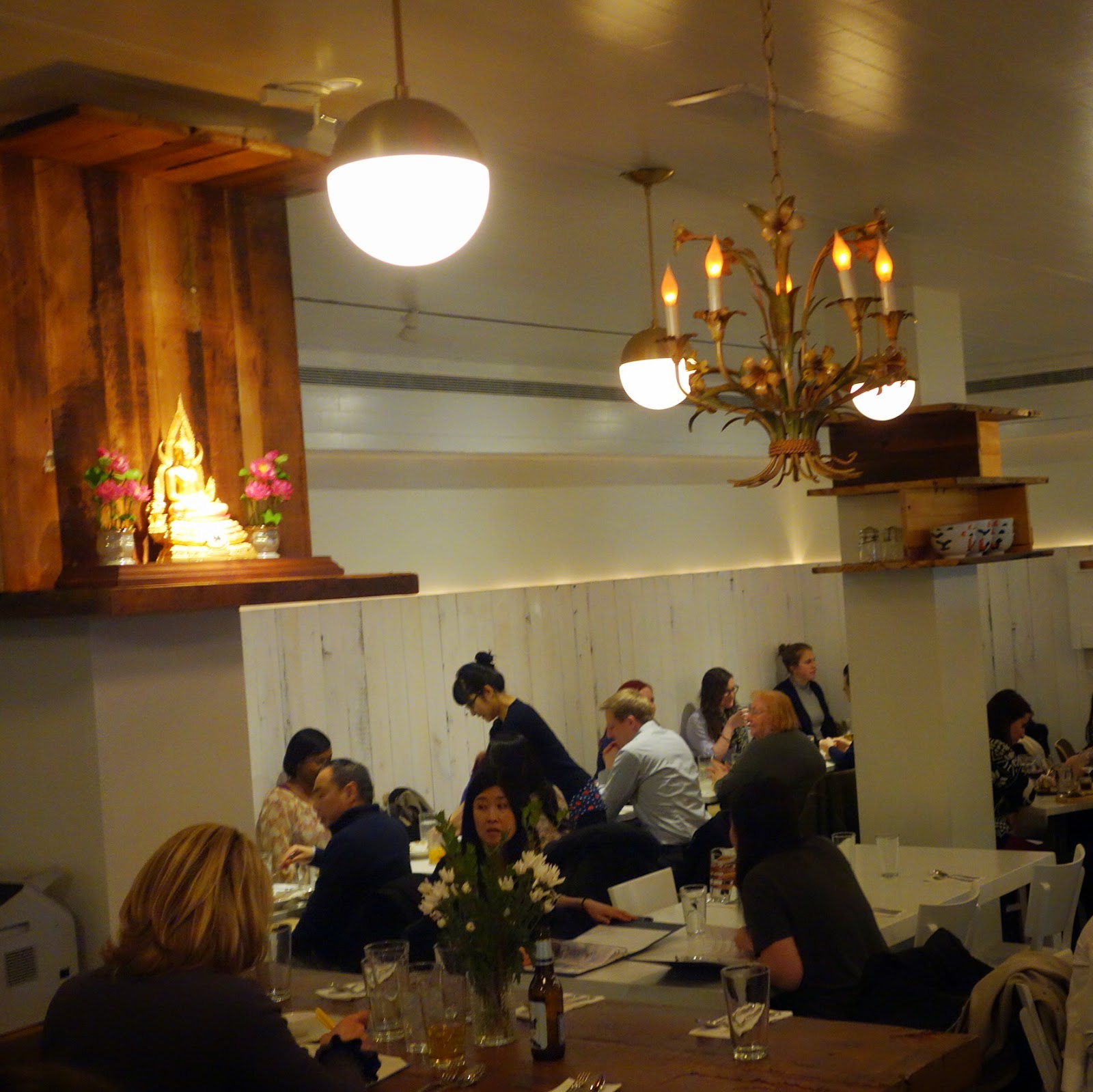
The room reminds me of Tom Sawyer's fence, thickly white-washed to mask all evidences of it predecessor's clubby black modernism.  A few illuminated Buddha statuettes and distressed mirrors break up the stark, farmhousy feel, but mostly it is the jubilance of the staff that creates the ambiance.   Servers and busboys may harbor some distinct linguistic frailties, but they are quick to fetch someone who can attend to your needs, with beaming smiles all along.  The person they will most likely fetch, too, is the indefatigable floor manager, who guidance was both well-given and well-taken.  I thought he was maybe an owner, but Phakphoom Sirisuwat and Supanee Kitmahawong are a younger, male/female duo, and chef Kornthanut Thongnum (yes, I'm glad they didn't name the restaurant after its proprietors) was certainly busy in the kitchen to be romping about the floor.   But our guide was so endearingly charming, he alone would motivate a return visit, even if the food wasn't alluring enough.  Thankfully, it is. 


We went with quite a few of his suggestions, the first of which he declared his favorite, a fragrant duck soup.  It's a strikingly flavorful bowl, the ruddy broth lurking below a similarly profound layer of vermillion oil.  How he could remain so lithe and consume this on a regular basis remains as mysterious as the nuanced layers of flavor, sweet and floral, bright and spicy, fruity and rich.  I was equally mystified about how to consume it: the oil slick constituted a barrier, to me, between the curry-inflected soup beneath, the hunks of rich duck meat and random fruity bits of loquat and grapes within.  Stirring things up dissipated some of the oil, but it might still be off-putting to the even remotely bikini-conscious.  Also, as the philosophy of the restaurant dictates sharing any and all.... 
How to Eat at Kiin

... so I wasn't sure how the flat plates in front of each of us could be used in divvying up a soup, so we ended just spooning from the same bowl, hoping all that heat and spice were somewhat antibacterial.  The rice we ordered didn't arrive 'til a bit later, too, which helped absorb both  the broth and some of the mounting heat: few dishes here are without punch.  Speaking of absorption, I figured out a way to un-fry food when an enormous bowl of braised chicken-leg curry noodles arrived crowned with a tangled mass of crispy fried noodles atop.  Given enough time in the gravy-like broth, the fried noodles achieved almost the same consistency as the boiled ones underneath, although (of course) adding some of their inherent richness to thicken the broth into a substantial sauce: little of the food at Kiin is rabbity fare, although the brightness,  balance and heat of everything belies some of its caloric impact.  

A good example of the brightness comes in the form of a corn salad, who's fishy funk was initially obscured with tang and spice.  Interspersing bites with other richer dishes, however, unearthed a the bracing smack of dried shrimp, so best consume this refreshing salad before the heat of most other dishes expose your palate to its nuances best left more subtle.   Supple salted eggs, hard-boiled, perch atop and help dissipate the flavors; the crunchy long beans and bulbous cherry tomatoes are left raw for the same reasons.   I feel like this is a good example of "authentic" Thai flavors: they can be an assault left to their own devices, but in convergence with all partnering elements, result in some tantalizing
 combinations.  Less thrilling may have been an offering from the Vegetarian section, tasty a plate of vegs though they were.  Griddled pucks of tofu fortified a sautee of asparagus and shiitakes, not much different than what you might find in any Thai/Chinese/Vietnamese/Pan-Asian joint, but in 
no way offensive.   Our next dish did offer up a bit of an insult- or at least to my taste, those lovely clusters of what turned out to be pickled peppercorns are definitely garnish and not palatable.  Spicy, pickly, fishy and bitter- and really, just plain stinky-  they were only visually appealing: what the menu qualifies as "unique fragrance" might originate from these funky bunches, and they should be left 
to the periphery along with the fibrous kaffir lime leaves .  The rest of the Pad Chaa, on the other hand, was highly edible, aggressively spiced with fiery chilis and garlic, although I think I would've preferred the seedy orbs of eggplant sauteed along with the fat shrimp and tender cylinders of squid,  instead of raw or nearly raw as they seemed to be.  

Hopefully you have come in a group, which is the only way to justifiably attack the most novel dessert option at Kiin: the "Num Kang Sai" Icy Mountain, which is not necessarily that good, yet still something to behold.  A behemoth mound of squiggling creamy ice- not quite sherbet nor granita but something smooth and refreshing just in between, a nice turn of events after all the heat of the meal.  It is flavored with a red syrup flavored from an indigenous Thai fruit that tastes a little (read: a lot) like bubble gum.  Alongside are small cups of accoutrments: a sticky coconut rice that would pair better with mangoes, sweetened red beans that would be more successful as a mochi filling, translucent globules that are apparently palm seeds and are just plain weird (although amusing), and oddly enough, kernels of yellow corn, which are really nothing BUT odd, as dessert, with or without the frozen pink slush.  
  A pot of green tea might be a more sophisticated way to end the evening, depending on your company and temperament.   Served in rough clay mugs with no handles, it allows your hands to appreciate the warm, rough texture of the rustic clay.  It feels simultaneously invigorating and soothing, warm and authentic and sort of Zen, which is much the sentiment I garnered from Kiin itself.  


36 E.8th Street (Between University Place & Broadway)
Tel. 212.529.2363